Learning Speed Is a Founder Skill: Learn Enough to Lead

You don't need to be technical to grow a business powered by technology. You need to learn fast enough to understand the problem, ask better questions, use the right tools and know when to bring in expertise.
Tolu runs a skincare brand in Lagos. Every week, customers in London and Toronto message her asking whether she ships abroad. Before she sends a single jar overseas, she decides to master export rules, international payments and global shipping. She buys two online courses and starts working through them.
Amaka runs a catering business with loyal corporate clients. She knows an ordering app would save her team hours every week and win her more contracts. She has no technical background, so she decides to learn to code before she speaks to a developer.
Six months later, both women know far more than they did. Neither has shipped a jar abroad or launched an app.
The market kept moving without them. New AI tools can now put together a simple ordering app in days. Delivery companies have started offering affordable door to door shipping for small brands selling abroad. And a competitor who knew half of what Tolu knows learned just enough to send a test shipment. She now has paying customers in London.
Tolu and Amaka didn't lack intelligence or effort. They were trying to learn everything before doing anything. What they needed was to learn enough to make the next decision, act on it, and learn again from what happened.
That ability has a name: learning speed. It's becoming one of the most valuable skills a founder can have. The World Economic Forum's Future of Jobs Report 2025 surveyed more than 1,000 of the world's largest employers. It expects 39 percent of the core skills workers rely on today to change by 2030, and it lists "curiosity and lifelong learning" among the skills rising fastest in demand.
When the skills a market rewards change this quickly, the founder who learns fastest and acts on it will often overtake the founder who started out knowing more.
What learning speed actually means
Learning speed is easy to confuse with consuming a lot of information. Someone can watch a hundred videos about AI and still have no idea how to use it in their business.
Here is a sharper definition: learning speed is how quickly new knowledge changes what you do.
Fast learners move through a simple loop, again and again:
Unknown → Understanding → Experiment → Feedback → Decision → Action
Tolu spent six months on the second step. A faster learner would have gone round the whole loop several times in that period, with a real shipment and real customer feedback at the end of each round.
Insight 1: Learn enough to lead the problem
Amaka never needed to become a software engineer. She needed to understand her app well enough to lead the project:
what the app must do for her clients, and what can wait
what is simple to create, and what is difficult
roughly what it should cost, and how long it should take
which tradeoffs each option carries
which questions to ask a developer before hiring one
Two or three weeks of focused learning would have given her that. Full technical expertise takes years, and she may never need it.
Aim for fluency: enough to hold an intelligent conversation and make the next decision well.
Insight 2: Everything you know has a shelf life
Knowledge loses value over time. Tools change. Customers change how they buy. Platforms change the rules of distribution. Regulations shift. What worked three years ago may already be out of date.
Experience still counts, because it gives you judgment. But in a changing market, the shelf life of what you know matters almost as much as how much you know. Founders who keep updating keep their expertise current. Founders who stop end up making today's decisions with yesterday's information.
Insight 3: Learning is a form of capital
We usually count a founder's capital as money, network, experience, technology and talent. There's another form worth counting: learning capital. It's the ability to walk into an unfamiliar field, grasp the fundamentals, find the questions that matter and become competent enough to act.
Money shrinks as you spend it. Learning capital grows each time you use it, because every new field is easier to enter than the last once you understand how you learn. That matters a great deal in international business and emerging markets, where rules, currencies and customer habits change from one country to the next.
Insight 4: AI shortens the road to understanding, and raises the cost of shallow knowledge
AI has changed how quickly a founder can get oriented. Microsoft and LinkedIn's 2024 Work Trend Index surveyed 31,000 people in 31 countries. It found that 75 percent of knowledge workers already use AI at work, and 78 percent of those users bring their own tools.
Used well, AI works like a patient tutor. Amaka could have asked:
"Explain how an ordering app works to someone who runs a catering business."
"What features matter most for corporate clients?"
"What questions should I ask a developer before I hire one?"
"Compare the costs of these three ways of building it for a business my size."
In a few afternoons, she could have moved from "I don't know how this works" to "I know exactly what to ask for."
That speed comes with a catch. In March 2025, Y Combinator's leadership revealed that about 95 percent of the code at a quarter of the startups in its Winter 2025 batch had been written by AI. YC was clear that these founders were highly technical, and its general partner Diana Hu explained why that mattered: "You have to have the taste and enough training to know that an LLM is spitting bad stuff or good stuff."
That's the lesson for every founder. AI can lower the cost of understanding, but judgment is still your job. Verify what it tells you, question it, and check important decisions with people who know the field deeply.
Insight 5: Collaborators multiply what you learn
Tolu tried to become an export expert herself. A faster route would have been to learn the basics, then spend an hour with a freight forwarder and a customs agent who handle shipments to the UK every week.
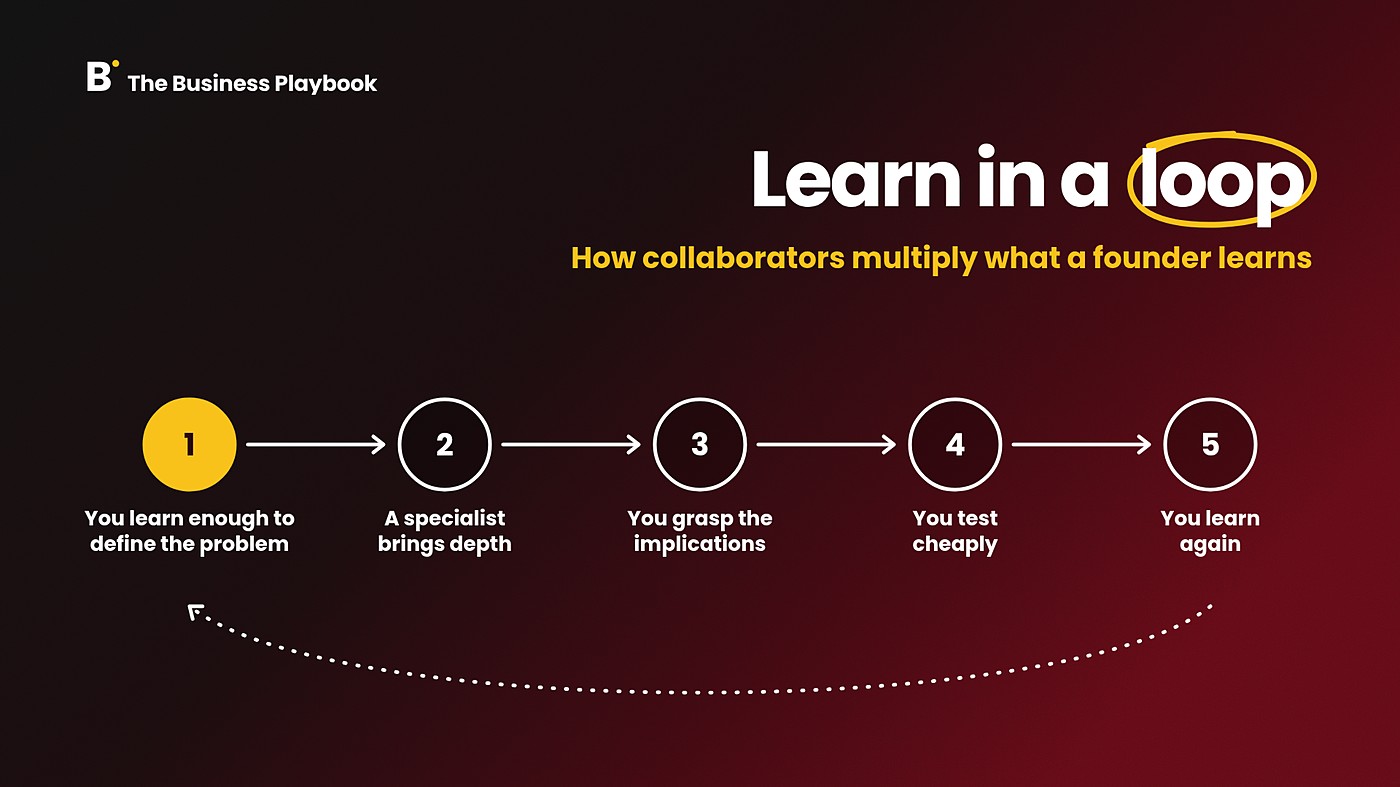
The strongest founders set up a learning loop with the people around them:
You learn enough to define the problem → a specialist brings depth → you grasp the implications → you test → you learn again.
A good developer, lawyer, accountant or logistics partner should leave you wiser after every conversation. If you leave meetings with experts no clearer than you went in, the partnership is costing you more than it should.
Insight 6: Knowing what you don't know is a founder skill
Two positions do real damage to businesses:
"I don't understand this, so I won't touch it." That one leads to missed opportunities.
"I don't understand this, but how hard can it be?" That one leads to expensive mistakes.
The stronger position sits between them:
"I don't know this yet. Let me find out what I need to know."
That's humility without paralysis. It turns a gap into a plan. What can I learn myself? What needs an expert? Who has that expertise? What can I test cheaply?
Your Learning Speed Test
The next time something unfamiliar appears in your business (a new tool, a new market, a new regulation), work through these seven questions:
What exactly don't I understand? Name the gap in one sentence.
What do I need to know to make the next decision? Aim for enough and set "everything" aside.
Can I learn it myself, quickly? If yes, start today.
Should I bring in an expert? If the knowledge is specialised, high risk or urgent, the answer is yes.
How can I test it cheaply? Turn the question into a small experiment.
What did the test teach me? Write the lesson down.
Which decision changes because of what I learned? This is the step that matters most.
If Tolu had used this test, her first experiment could have been twenty jars shipped to five customers in London by the end of her first month. Every lesson from that shipment would have been worth more than a chapter of her course.
If no decision changes, you've only collected information. Learning has happened when your next move is different.
A word on expertise
None of this argues against depth. Experts are essential, and some parts of your business deserve years of study: your core product, your finances, the craft your customers pay you for. Keep deepening that knowledge. The risk comes when the pursuit of mastery holds back decisions that only needed enough understanding, a good collaborator and a small test. Learn enough to move, bring in experts where depth matters, and keep growing your own expertise along the way. For a founder, speed is part of the strategy.
The advantage that lasts
The founders who go furthest rarely start out knowing everything their business requires. Their edge sounds more like this:
"I can learn what I need, find people who know what I don't, use the tools around me, and turn what we learn into action."
Markets will change. Tools will change. What you know today will age. The speed at which you can learn again is the advantage nobody can take from you.
So here is my question for you: what have you been waiting to fully understand before you act?
Sarah Adesemoye, The Business Playbook
Sources
World Economic Forum, Future of Jobs Report 2025 (January 2025): https://www.weforum.org/stories/2025/01/future-of-jobs-report-2025-jobs-of-the-future-and-the-skills-you-need-to-get-them/
Microsoft and LinkedIn, 2024 Work Trend Index (May 2024): https://blogs.microsoft.com/blog/2024/05/08/microsoft-and-linkedin-release-the-2024-work-trend-index-on-the-state-of-ai-at-work/
TechCrunch, "A quarter of startups in YC's current cohort have codebases that are almost entirely AI-generated" (March 2025): https://techcrunch.com/2025/03/06/a-quarter-of-startups-in-ycs-current-cohort-have-codebases-that-are-almost-entirely-ai-generated

Founder and global business strategist More from The Business Playbook


