Global Value Chains: Your Business Doesn't Have to Do Everything

Who made the phone you are reading this on?
If it is an iPhone, the back gives you a clue: Designed by Apple in California. Assembled in China. Yet that line leaves out most of the story. The chips may have come from Taiwan, the display from South Korea, the camera sensor from Japan. Some models are now assembled in India. Shipping, marketing and retail happen across dozens of other countries.
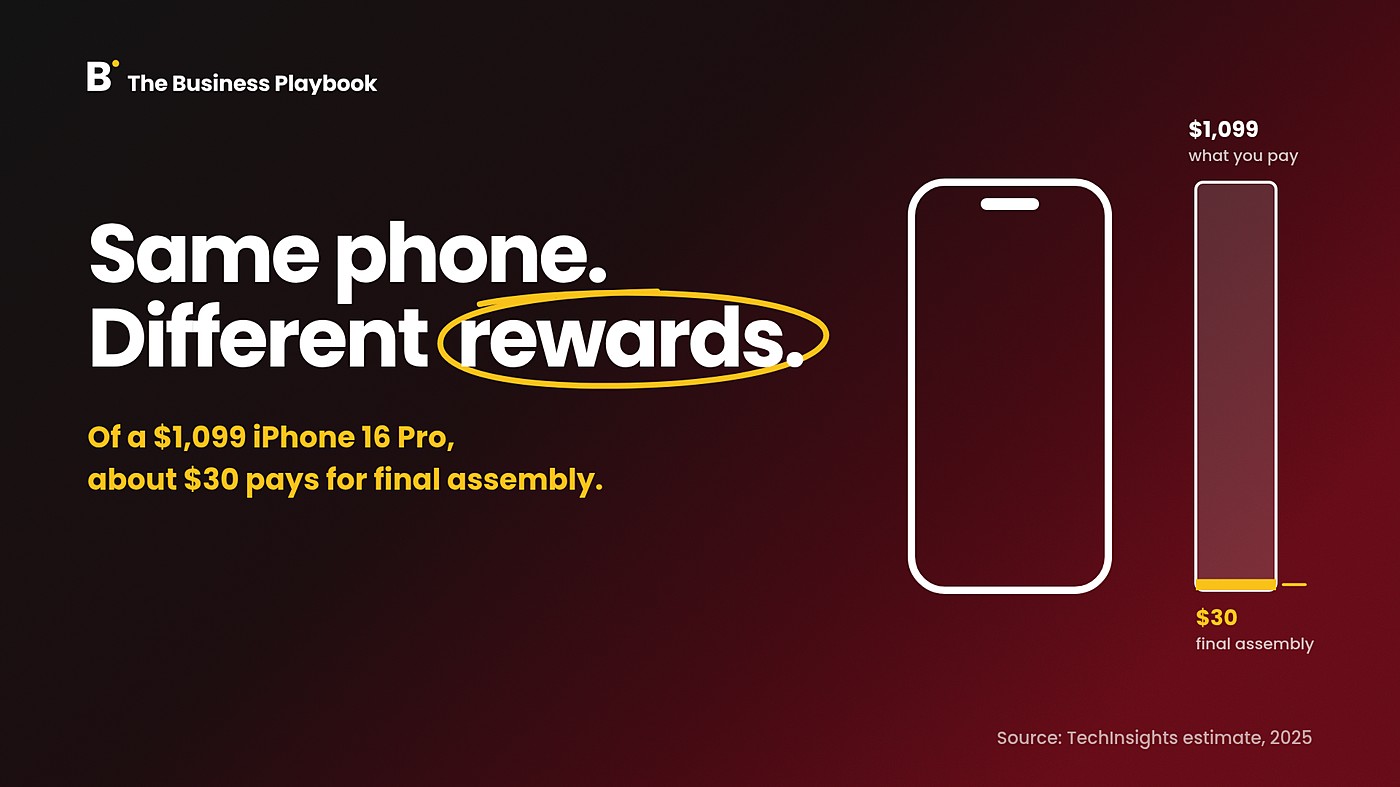
Here is the part most people never think about. In 2025, TechInsights estimated in a Wall Street Journal analysis that a 256GB iPhone 16 Pro costs Apple about $580 to make. It sells for $1,099. Of that $580, final assembly and testing in the factory accounts for roughly $30, less than 3 percent of what the customer pays. Apple keeps more than $500 of every sale before paying for its own research, software and marketing.
Same product. Very different rewards.
The reason comes down to one idea every founder should understand: the global value chain.
What a global value chain actually is
A value chain is every step it takes to turn an idea into something a customer pays for. It becomes a global value chain when those steps happen in different countries.
It usually looks something like this:
Idea → Research → Design → Raw materials → Production → Logistics → Marketing → Distribution → Retail → Customer
Each link adds value. Each link does not earn the same amount. And no business is required to own every link.
According to the Global Value Chain Development Report 2025, launched at the WTO in December 2025, trade linked to global value chains made up 46.3 percent of all global trade in 2024, only slightly below its 2022 peak of 48 percent. That is close to half of everything the world trades. Whether you realise it or not, your business probably sits somewhere inside one.
So the useful question for a founder is this: where along the chain can you create value that others struggle to replace?
Insight 1: The maker is rarely the biggest winner
Most of us assume the business that produces something earns the most from it. It feels fair. They did the hard work.
The numbers tell a different story. Value tends to gather at the two ends of the chain. At the start sit research, design, technology and intellectual property. At the end sit the brand, distribution, customer relationships, data and after-sales service. Production usually sits in the middle, where competition is fierce and margins are thin.
Stan Shih, the founder of Acer, drew this as a curve shaped like a smile: high on both ends, lowest in the middle. It became known as the Smile Curve, and three decades later it still explains why assembly earns so little.
Cocoa is an example close to home for many of us. Côte d'Ivoire and Ghana grow more than half of the world's cocoa. Yet most of the money in a chocolate bar goes to the companies that process, brand and sell it, usually far from the farms.
"Made in" tells you where something was produced. It says very little about where the money was made.
Insight 2: Own what matters. Partner for the rest.
Many entrepreneurs carry a hidden belief that a serious business must own its factory, its warehouse, its delivery fleet and a large team.
Some of the world's most valuable companies disagree. Apple does not run the factories that assemble its phones. Nike has long relied on independent manufacturers to make its shoes. What both guard closely is design, brand, technology and the customer relationship.
A sharper question for your business: which activities give us our edge, and which could a capable partner handle as well as we can, or better?
Owning everything can feel safe. It also ties up cash, attention and time in activities that may never set you apart.
Insight 3: Moving up can matter more than producing more
A business can double its output and still sit in the same weak position. More volume in a low-margin link often means more work for the same thin return.
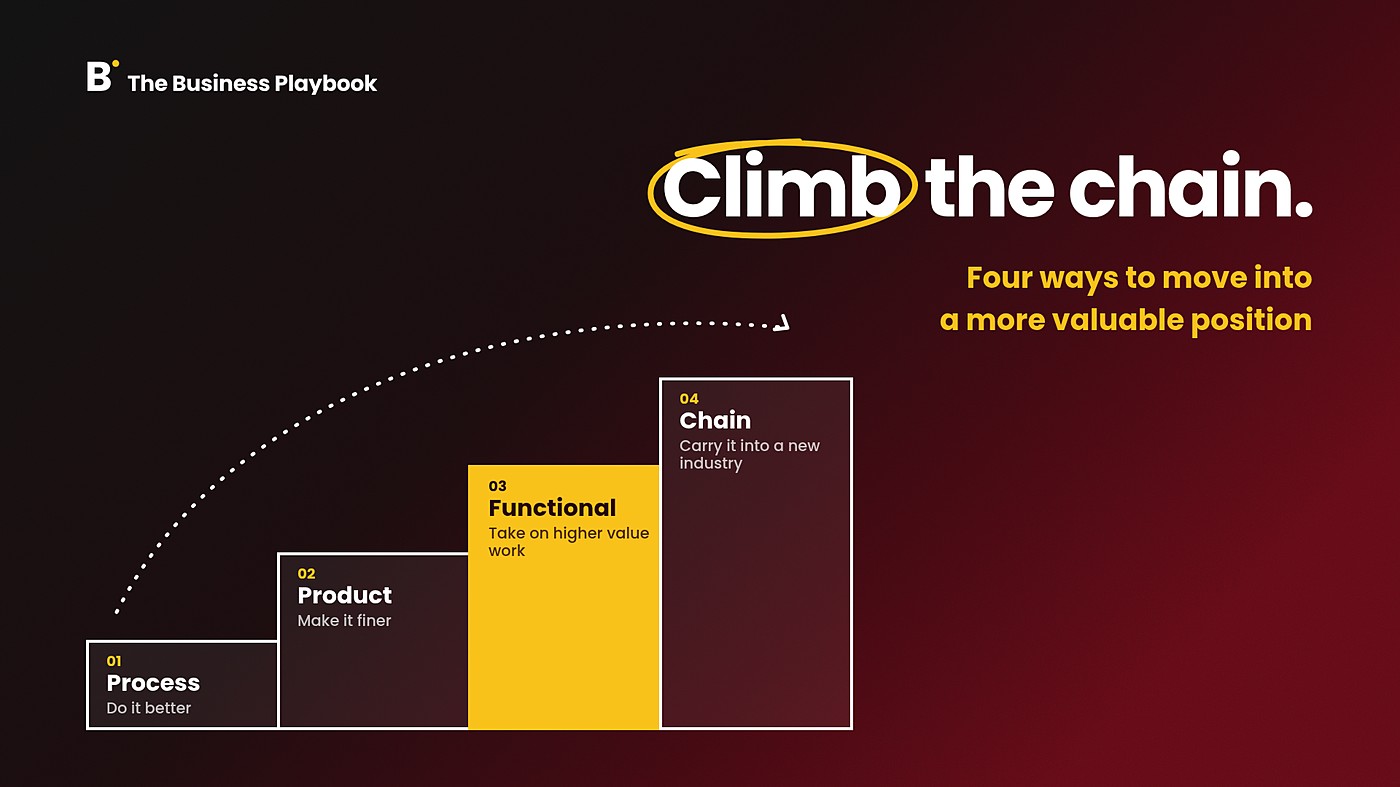
People who study value chains describe four ways a business can climb into a better position. They call it upgrading:
Process upgrading: doing what you already do more efficiently. A bakery that cuts waste and delivery time.
Product upgrading: offering something more refined. A tailor who moves from basic uniforms to made-to-measure suits.
Functional upgrading: taking on higher-value activities. A garment factory that starts designing and selling under its own label.
Chain upgrading: carrying your skills into a new industry. A logistics company that turns its delivery data into software for other businesses.
Of the four, functional upgrading is often where the economics of a business change the most.
Insight 4: Going global does not mean selling everywhere
When founders hear "global business," many picture offices in five countries. That is only one version.
You are already doing international business if you source materials from abroad, sell to customers in another country, license your technology overseas, work with a foreign manufacturer, or partner with a distributor in a new market.
Global business means taking part, wisely, in the cross-border systems that create value. One well-chosen link abroad can be worth more than a presence in ten markets.
Insight 5: Sometimes the next market is a higher layer
When growth slows, the reflex is to look for a new country. Often the bigger opportunity sits in the same market, one layer up.
A manufacturer producing for other brands can launch its own. A distributor can turn its sales records into insight that suppliers will pay for. A consultant can package expertise into a course or a product. A retailer can develop a private label.
Change your position before you change your geography. It is often cheaper, and it can improve your margins faster.
Insight 6: Small businesses belong in these chains too
"Global value chain" sounds like vocabulary for multinationals. In reality, large chains depend on small, specialised firms every day: a component supplier, a design studio, a software developer, a packaging maker, a creative agency, a logistics partner.
Having trained over 1,500 young entrepreneurs, I have seen how often founders assume size is the entry ticket to global markets. The real entry ticket is one capability that someone else in the chain values and cannot easily find elsewhere.
Your Global Value Chain Audit
Set aside thirty minutes with your team and answer these honestly:
What exactly do we do? Break it into specific activities. "We sell fashion" is too broad.
Where does each activity happen, from supplier to customer?
Which activities do we own, and which do we outsource?
Where are we genuinely better than others?
Who controls the relationship with the customer?
Who creates and owns the intellectual property: the designs, the formulas, the software, the brand?
Which link in our chain earns the most money? Is it ours?
Could we move one step closer to the customer, or one step closer to the idea?
Could what we do well serve another industry or market?
Your answers will show you where your business sits on the smile curve, and which direction to move.
The link that belongs to you
The next time you pick up a product, look past the label. Ask who designed it, who owns the customer, and who kept the largest share of the price.
Then ask the same questions about your own business.
The companies that compete well across borders rarely do the most. They know precisely which link belongs to them, and they make that link very hard to live without.
Which link in the chain is yours?
Sarah Adesemoye, The Business Playbook
Sources:

Founder and global business strategist More from The Business Playbook


